
Skinmap Total Body Photography
It’s very hard to track every mole on your body on your own, and it’s not because you haven’t tried. Moles can move, fade or change so slowly over time that even a trained eye can miss small differences from one visit to the next.
Our latest service, Skinmap fills that gap. The Skinmap gives you a full visual record of your skin at a single point in time. At Advanced Dermatology, P.C., our dermatologists use that record to track any changes across future visits, so they have something concrete and documented to measure against, instead of memory, individual photographs, or written records alone. That side-by-side comparison matters most for people who have a large number of moles, irregular moles, dysplastic nevi, a personal history of skin cancer or a family history of melanoma.
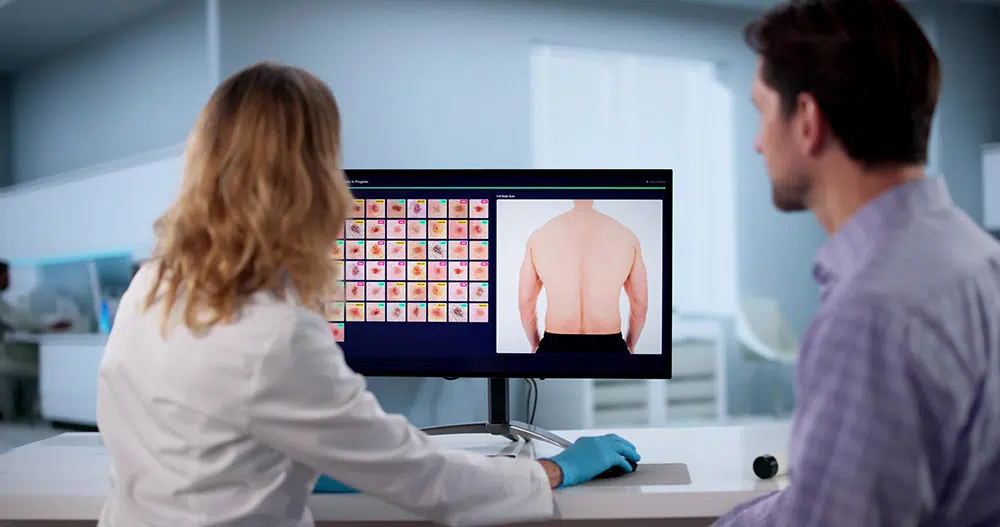
The program we use at Advanced Dermatology, P.C. is built around Skinmap, an AI-assisted imaging tool that supports our clinical assessments. The way it works is pretty simple: the technology handles the documentation, and our dermatologists manage the evaluation and treatment if needed.
What that combination gives you is a level of scheduled skin surveillance that a standard visual exam just can’t match on its own.
For people who may fall into a higher-risk group, or who just want greater reassurance between annual visits, this type of long-term monitoring can be legitimately worthwhile. Our dermatologists are happy to talk through whether this program makes sense for your situation. Many insurances cover this innovative procedure in the at risk patient.
How Skinmap Works and What It Does
Total body photography gives a full picture of your skin, and Skinmap is the technology we use to make that happen. It’s an AI-assisted imaging tool that captures full-body photos of your skin so we can track changes over time and compare what the growths on your skin look like from one visit to the next.
That last part carries more weight. Small skin changes (the kind that you might miss during a single exam) are much easier to catch when we have a reliable baseline to go back to. Skinmap gives us just that, a steady visual record that travels with you through every appointment.
We should also be upfront about what Skinmap actually does and what it doesn’t do. The technology itself does not read, interpret, or diagnose any lesion. Its job is to support the clinical judgment of our dermatologists at Advanced Dermatology, P.C., so they have a well-organized visual reference to work from. Every assessment and every choice about your care still comes directly from your doctor. Skinmap just gives them more to work with and allows them to pick up on early changes and warning signs.
The tool pairs especially well with our skin cancer screenings. A documented history of your skin matters in how your dermatologist evaluates what they see. If something has changed since your last visit, we want to catch it – and Skinmap helps us do that with far greater accuracy than your memory or handwritten notes alone.
How Skinmap Works From Start to Finish
Here is how the Skinmap process works, from start to finish.
We photograph your entire body in about 60 seconds with our dedicated imaging system. It’s painless, with no radiation involved whatsoever, just light and a small amount of your time. The full-body image we capture maps every mole, freckle and skin marking across your body. That image then serves as a baseline on file with us at Advanced Dermatology, P.C. We typically take between 300-400 photographs and carefully map out your entire body.
At your next visit, we photograph you again and then place the two sets of images side by side for a direct comparison: this is where Skinmap earns its value. Changes that would be extremely easy to miss with the naked eye are far more apparent when you have a documented before-and-after record to reference. If anything has changed, grown or come up since your last visit, we flag it for your dermatologist to review.
The whole experience is easy. There’s nothing to prepare or plan for ahead of time. Most patients are in and out well within the time they had set aside for it.
As for why we recommend repeat visits, it’s because skin does change over time, and a photographic record that builds with each visit gives your dermatologist a much stronger foundation to draw from as they make decisions about your care. Instead of relying on memory or a quick visual scan during an exam, they’ll have a documented history to reference. Over time, that record proves to be one of the most useful tools your dermatologist has for catching anything worth a second look.
Who Gets the Most From Total Body Photography?
Total body photography at Advanced Dermatology, P.C. fits anyone who wants to be proactive about their skin health – and a few groups of patients get value out of it in particular. This service is worth a look if you have a high mole count, a personal history of skin cancer (basal cell, squamous cell or malignant melanoma), or a close family member who has had melanoma or other skin cancer. Patients with fair skin or repeated sunburns also usually fall into this category because fair skin calls for a closer watch on changes over time.
The whole idea behind total body photography is to get out ahead of your skin health – not to wait for something to change and then try to catch it. With a full visual record on file, your dermatologist at Advanced Dermatology, P.C. can compare your images side by side at each visit and pick up on even the subtlest differences.
Between appointments, it also helps you to have a basic sense of what to look for on your own skin. Knowing the early warning signs of skin cancer can make you feel more confident during your own at-home checks. For patients who have already gone through a melanoma diagnosis or treatment, scheduled photography plays an especially helpful role in their long-term care.
At Advanced Dermatology, P.C., we’re always happy to answer your questions about anything. If you’re not sure whether total body photography makes sense for your situation, just reach out. Our team can talk through your options and help find the right path forward.
Your Session: What to Expect
A Skinmap session at Advanced Dermatology, P.C. usually runs about 10-15 minutes from the time you walk into the time you’re done. One of our trained medical assistants or nurses will perform the scan itself, and then one of our dermatologists reviews your images as a standard part of your care plan as well as performing a detailed total skin body exam.
Does Your Insurance Cover a Skinmap Session?
Total body photography is covered by many insurance plans. Medicare covers it in the appropriate patient, as do a number of private insurance carriers, patients need to meet eligibility criteria before the service gets approved.
At present, the most common qualifying factors include a diagnosis of dysplastic nevi (atypical moles), a personal history of melanoma, or a family history of skin cancer or melanoma. If any of these apply to you, there’s a great chance your plan will cover at least part of the cost, if not all of it.
Every insurance plan is a little different, and coverage ultimately can depend on your plan and your eligibility at the time of your visit.
If you’re not sure how to approach that conversation, or want a little input on what questions to ask, our team at Advanced Dermatology, P.C. is happy to help point you in the right direction.
Schedule Your Skinmap Appointment
A documented record of your skin over time is one of the most helpful tools that you can have for your long-term health. It gives your care team something concrete and visual to refer back to, visit after visit.
Whether you’ve been putting off a skin, nail, or hair concern or you just want to get a baseline on the record, our team is here to help. Advanced Dermatology, P.C. has a network of board-certified dermatologists, plastic surgeons, allergists and skin care specialists who can work with you to build a monitoring plan that actually fits your history and your preferences. With 40+ locations across New York and New Jersey, getting started is easy.
Frequently Asked Questions
We get questions about total body photography and what the Skinmap process actually involves, so we’ve pulled together some of the ones we hear most often to help you decide if it’s right for you.
Does Skinmap diagnose skin cancer or tell me if a mole is dangerous?
No, Skinmap does not diagnose or interpret any lesion on its own. It’s an imaging tool that gives you a visual record of your skin, which our dermatologists then use to help make their clinical judgment. The assessment and care decisions come from your doctor, not from the technology.
How long does the whole appointment take?
Most sessions run around 10 to 15 minutes from start to finish. The imaging itself takes about 60 seconds – it’s painless, it involves no radiation, and there’s nothing you’ll have to do or bring with you beforehand.
Who actually performs the scan – a doctor?
The scan itself is performed by one of our trained medical assistants or nurses – not by a dermatologist in the room with you. That said, a dermatologist does review every image before anything is acted on, so your care is always in clinical hands.
Is this service covered by insurance?
Yes, total body photography is often covered by insurance plans (like Medicare and most major private carriers) for patients who meet criteria such as having dysplastic nevi or a personal or family history of skin cancer or melanoma. Coverage can depend on your plan, so we recommend checking with your insurer – and we’re happy to help you look into that.
Who is this service meant for?
Total body photography is especially helpful if you have numerous moles, a personal or family history of skin cancer or melanoma, or fair skin that warrants closer watching over time. That said, anyone who wants a reliable baseline record of their skin can benefit from having one in place.
What is the cost if the patient does not have insurance (self pay) or insurance does not cover it?
Most insurance plans cover the procedure for eligible patients. Our current fee of $80 is intentionally kept well below the cost typically charged by other providers in New York City, making this groundbreaking, state-of-the-art technology more accessible to our patients and helping support earlier detection that could ultimately save your life.