
Medically reviewed by Joshua Fox, MD, FAAD and Loretta Pratt, MD · September 2026
What are skin tags?
Skin tags, also called acrochordons, are common, benign growths that usually form in areas where skin rubs against skin or clothing. This skin condition may appear on the neck, underarms, eyelids, groin or other areas of the body.
Skin tags are more common in adults and may be more likely to develop during pregnancy or in people who have obesity, diabetes or metabolic syndrome. Having skin tags does not necessarily mean that you have an underlying health condition, however.
Most skin tags do not require treatment unless they become irritated, painful, bleed, affect your vision or bother you cosmetically.
Are skin tags dangerous?
Most skin tags are harmless and do not need to be removed for medical reasons. However, you may mistake another type of skin growth for a skin tag. The American Academy of Dermatology notes that some growths that look like skin tags may need evaluation by a dermatologist.
A growth that changes, bleeds, becomes painful or otherwise looks unusual should be evaluated by a board-certified dermatologist rather than treated at home.
This is especially important if you notice a new or changing growth and are not sure what it is. A dermatologist can examine the area and determine whether it appears to be a skin tag or something that requires further evaluation.
Don’t assume that a growth is a skin tag simply because it looks similar to one you have had before. If you have concerns about a changing or unusual growth, your dermatologist can also discuss whether skin cancer screening may be appropriate.
Getting an accurate diagnosis before removal can help you avoid treating the wrong type of growth. The American Academy of Dermatology’s information on skin tags also notes that some growths that look like skin tags may need evaluation by a dermatologist.
Common at-home skin tag removal methods
The first category of skin tag remedies you may find online involves a natural substance, usually one you might have in the kitchen, and a band-aid. Most commonly this will be apple cider vinegar, and sometimes coconut oil – some of them even involve honey, banana peels, or baking soda. Soak a cotton ball in the substance and apply it to the skin tag, then replace it every few hours.
These remedies have limited effectiveness, and if they work, it may take several weeks or even months to see results. They can also irritate the surrounding skin, particularly when acidic or otherwise irritating substances are repeatedly applied.
Tea tree oil and topical remedies
Tea tree oil, apple cider vinegar and other topical home remedies are sometimes promoted as ways to remove skin tags. However, limited evidence shows these remedies can safely and reliably remove skin tags. Applying irritating substances to the skin can cause redness, burning or other irritation without addressing whether the growth is actually a skin tag.
For this reason, attempting to remove a skin tag with a topical home remedy is generally not a safer alternative to professional removal.
Tying off or freezing kits
You might see a few over-the-counter remedies for skin tags at the grocery or drug store, but dermatologists do not recommend these products.
They come in three categories:
- Cryotherapy kits that freeze the tag away
- Ligation bands that cut off the tag’s blood supply
- Patches placed over the tag that contain medicine intended to remove the tag
Cryotherapy kits may work, but there’s no guarantee that they will reach the right temperature to remove the tag, and ligation bands and patches simply may not work at all. These methods can also injure the surrounding skin and may cause irritation, bleeding, infection or scarring.
Cutting or clipping at home
As a last resort, you may be tempted to remove a skin tag with something sharp, like nail clippers or a very sharp pair of scissors. There are even some sources that suggest tying it off with dental floss.
Please don’t attempt to remove your skin tag with a sharp object at home!
Skin tags may contain blood vessels, and you could accidentally hurt yourself worse than you intend and leave yourself vulnerable to infection.
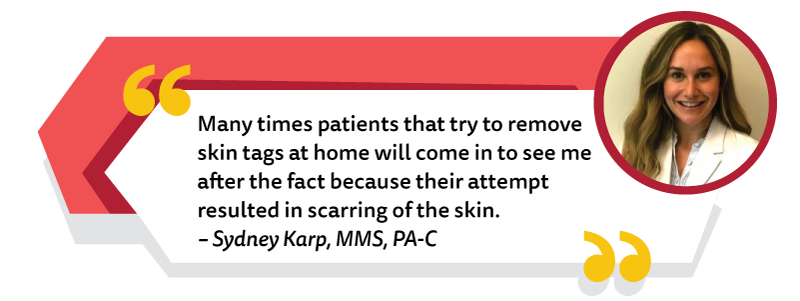
Even if the growth is small, cutting into the skin can cause bleeding and scarring. Without a dermatologist examining the growth first, you also risk removing something that only looks like a skin tag.
Risks of removing skin tags at home
The biggest concern with at-home skin tag removal is that a DIY method can cause an injury without addressing the actual growth. Depending on the method used, possible problems include:
- Infection
- Bleeding
- Scarring
- Skin irritation or burns
- Pain
- Damage to the surrounding skin
- Delayed diagnosis if the growth is not actually a skin tag
Cutting or clipping a growth yourself can cause bleeding, while caustic or irritating products may damage the skin around the growth. Even products marketed specifically for skin tag removal may not be appropriate or safe to use at home.
There is also an important diagnostic concern. Some other skin growths can resemble skin tags. Removing a growth without having it evaluated first could delay the diagnosis of a condition that needs medical attention.
If you are unsure what a growth is or if it is changing, bleeding, painful or otherwise unusual, have a dermatologist evaluate it before attempting removal.
How dermatologists remove skin tags
Dermatologists remove skin tags in a few different ways. The method your dermatologist recommends may depend on the size and location of the skin tag, along with other factors. Common professional removal methods include:
- Cryotherapy: Uses liquid nitrogen to freeze the skin tag.
- Excision: The dermatologist numbs the area and removes the skin tag with a scalpel or sterile medical instrument. A “snip” technique may also be used for some skin tags.
- Electrodesiccation: Uses electrical energy to destroy the skin tag.
Depending on the size of the tag, you may need local anesthesia, but don’t worry – these procedures typically have a very low risk of complications and little recovery time.
Professional removal allows your dermatologist to control the treatment and reduce the risk of unnecessary injury to the surrounding skin.
What to expect during professional removal
Skin tag removal is often performed during an office visit. Your dermatologist will first examine the growth and determine whether it appears to be a skin tag. Depending on the removal method, the area may be numbed with a local anesthetic.
After removal, you may have a small wound, scab or area of irritation while the skin heals. Your dermatologist can provide aftercare instructions to help protect the area and reduce the risk of complications.
When to see a dermatologist for skin tags
If you have a skin growth that you believe is a skin tag, a board-certified dermatologist can confirm what it is and discuss whether removal is appropriate. You should especially consider seeing a dermatologist if the growth is changing, bleeding, painful, irritated or difficult to identify.
A dermatologist can also help if you have tried an at-home remedy and developed irritation, bleeding or another skin problem. Professional removal can provide a safer alternative to cutting, freezing or applying potentially irritating substances yourself.
If you want a skin tag removed for cosmetic reasons, your dermatologist can explain your treatment options and what to expect during and after the procedure.
Frequently asked questions
Does removing a skin tag cause more to grow?
No. Removing a skin tag does not cause additional skin tags to grow in other areas. However, people who are prone to developing skin tags may develop new ones over time. Removing one skin tag does not prevent others from developing.
Can skin tags be a sign of something more serious?
Most skin tags are harmless. However, not every skin growth that looks like a skin tag is actually a skin tag. A growth that changes, bleeds, becomes painful or looks unusual should be evaluated by a dermatologist before you attempt to remove it.
Does insurance cover skin tag removal?
Insurance coverage depends on the reason for removal and your individual insurance plan. When a skin tag is removed because it is medically necessary, coverage may be possible. Cosmetic removal may not be covered. Check with your insurance company and dermatologist’s office about your specific situation.
How long does professional skin tag removal take?
Skin tag removal is often a quick office procedure, although the amount of time can vary depending on the number, size and location of the skin tags and the removal method used. Your dermatologist can explain how long your specific procedure is expected to take and what, if any, aftercare will be needed.